Uterine artery Doppler ultrasound
Information for women and their families
This leaflet explains what the scan is and what will happen when you arrive at the hospital for your appointment. If after reading this leaflet you have any further questions or concerns, please speak to your midwife.
Why have I been offered this type of scan?
You have been offered a uterine artery Doppler ultrasound scan, as you have additional medical, or previous pregnancy risk factors. These risk factors mean there is an increased chance of:
early onset Fetal Growth Restriction; and
increased risk of pre-eclampsia.
Fetal Growth Restriction is a condition where some babies do not grow well. This means they are smaller or lighter than they should be for that stage of pregnancy.
Pre-eclampsia is a complication of pregnancy that causes you to have high blood pressure and protein in your urine. The risk factors for this include the following.
Complex medical conditions
Previous or current hypertensive disorder
Low PAPP-A
What is a uterine artery?
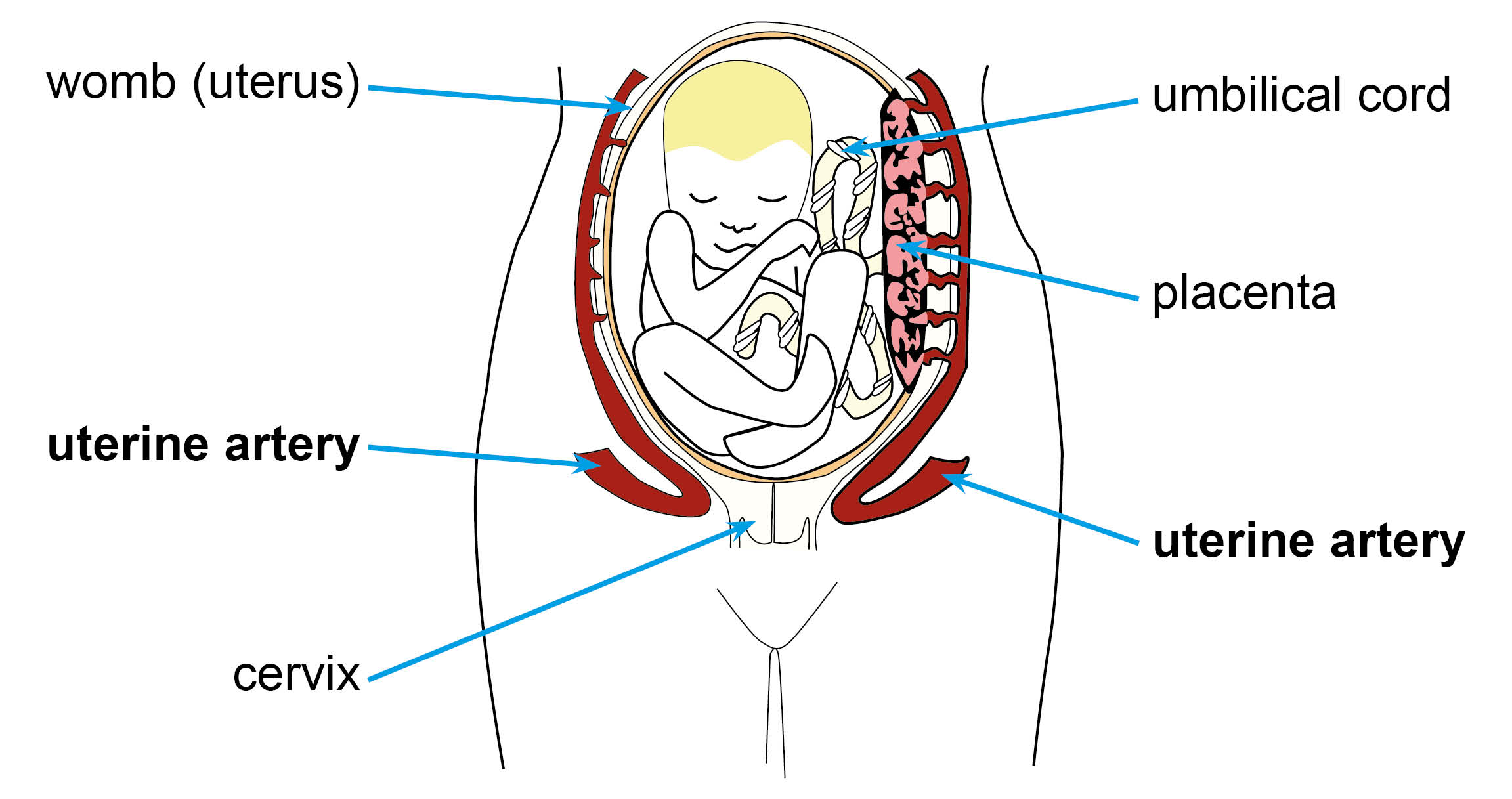
Uterine arteries carry blood to your womb (uterus). Every woman has two uterine arteries one on either side of their womb. These arteries supply the blood flow to the womb, which then feed the placenta. If there is a good blood flow in these arteries the placenta is more likely to develop normally, helping the baby to grow in a healthy way inside the womb.
What is a uterine artery Doppler ultrasound measurement?
A Doppler ultrasound measurement is used to check the blood flow in your uterine arteries. It is a simple ultrasound scan (similar to the ultrasound scan you had at 20 weeks). The Doppler measurement uses sound waves to check if:
your blood is flowing easily (low resistance); or
whether your blood is not flowing as smoothly (raised resistance).
What happens during my scan?
Please refer to your appointment letter for details of your scan.
You will be taken into a room in the Maternity Department by a member of staff. They will explain what is going to happen during your scan. Use this time to ask questions or raise any concerns you may have. Remember you can withdraw your consent for screening at any time.
The scan will be performed in the same way as other maternity scans.
The sonographer or a senior doctor will place some gel on your lower tummy.
They will pass a probe over the gel; an image will then appear on the screen.
Ultrasound scans are painless. Occasionally, they may be a little uncomfortable if you have a very full bladder. They have no known side effects. Please talk to your healthcare professional about any concerns you have.
How long will the procedure take?
The scan can take up to 45 minutes. You can leave the hospital straight after your scan.
Are there any risks to having this procedure?
No, there are no risks to having this scan.
When will I get my results?
The sonographer will let you know your results after your scan.
What do the results mean?
A low resistance flow means that a good, steady amount of blood is reaching your womb. This will help your baby to continue to grow well. A normal result also shows that you are less likely to develop pre-eclampsia. You will be offered growth scans every three to four weeks from 32 weeks in your pregnancy. We offer these scans to monitor your baby’s growth.
Sometimes the measurement will show a raised resistance. This suggests there is an increased chance of your baby not growing as well as expected, or an increased risk of you developing pre-eclampsia. It is important to understand that this does not mean that this will happen, only that you are at increased risk. You may be advised to take low dose aspirin if the resistance is raised. For more information, please read the Low dose aspirin (150mg) in pregnancy leaflet.
What will be done if the Doppler measurement shows raised resistance?
If your measurements show a raised resistance or positive screen, we will offer you:
further monitoring;
more ultrasound scans; and
more hospital or midwife appointments during your pregnancy.
This means that if problems do arise they can be found as early as possible.
Is there anything I can do to help my baby to grow well?
If you smoke it is very important that you stop, as it can affect placental (afterbirth) function and your baby’s growth. If you need support to stop smoking, please speak with your midwife or doctor. You can also self-refer to our in-house service through One You Kent.
One You Kent
Telephone: 0300 123 1044
Email
Monitoring your baby’s movements is a good way for you to check your baby’s wellbeing.
Who can I speak with if I need further information?
Being asked to have further screenings may cause you anxiety, but please be assured that most babies will grow normally.
Please contact Maternity triage if you have any worries, concerns or further questions.
Maternity Triage
Telephone: 01227 206737; Open Monday to Sunday, 24 hours a day.
Further information
Royal College of Gynaecologists (RCOG). Pre-eclampsia. February 2022.
Tommy's. Fetal growth restriction (Intrauterine growth restriction).
East Kent Hospitals. Low dose aspirin (150mg) in pregnancy patient leaflet.
East Kent Hospitals. Low pregnancy associated plasma protein-A (PAPP-A) patient leaflet.
[Web sites last accessed 19 February 2026]
What do you think of this leaflet?
We welcome feedback, whether positive or negative, as it helps us to improve our care and services.
If you would like to give us feedback about this leaflet, please fill in our short online survey. Either scan the QR code below, or use the web link. We do not record your personal information, unless you provide contact details and would like to talk to us some more.
If you would rather talk to someone instead of filling in a survey, please call the Patient Voice Team.
Patient Voice Team
Telephone: 01227 868605
Email