TENS: The Kent Centre for Pain Medicine and Neuromodulation
Information for patients
Your pain specialist has prescribed Transcutaneous Electrical Nerve Stimulation (TENS) treatment to help your chronic pain. This booklet has been produced to help you to use the machine effectively.
TENS machines can be used for all types of pain. The specialist nurse will show you how to fit and use your TENS machine.
TENS is a drug free method of controlling pain that is effective for 75 out of every 100 patients. It is not a cure, but may significantly reduce your pain making life more tolerable.
We hope this leaflet answers some of the questions you may have. If you have any further questions or concerns, please speak to a member of your healthcare team.
How does TENS work?
TENS is thought to work in two ways.
By electrically rubbing the pain better. This acts to distract your nervous system. As your brain can only deal with so much information at one time, it lessens the amount of pain you feel.
By stimulating your body to produce its own painkillers (endorphins).
Note: TENS is only designed to work when you are wearing the machine and have it turned on.
When should I not use TENS?
If you have a pacemaker.
If you are pregnant you will need further instructions during the first 3 months. We will give you the instructions at your Pain Clinic appointment.
If you are epileptic we will give you further instructions at your Pain Clinic appointment.
In bed when sleeping.
In the bath or shower.
When driving; check the details with your insurance company.
How do I use the TENS machine?
-
 1. Attach the leads to the pads.
-
 2. Position the pads.
-
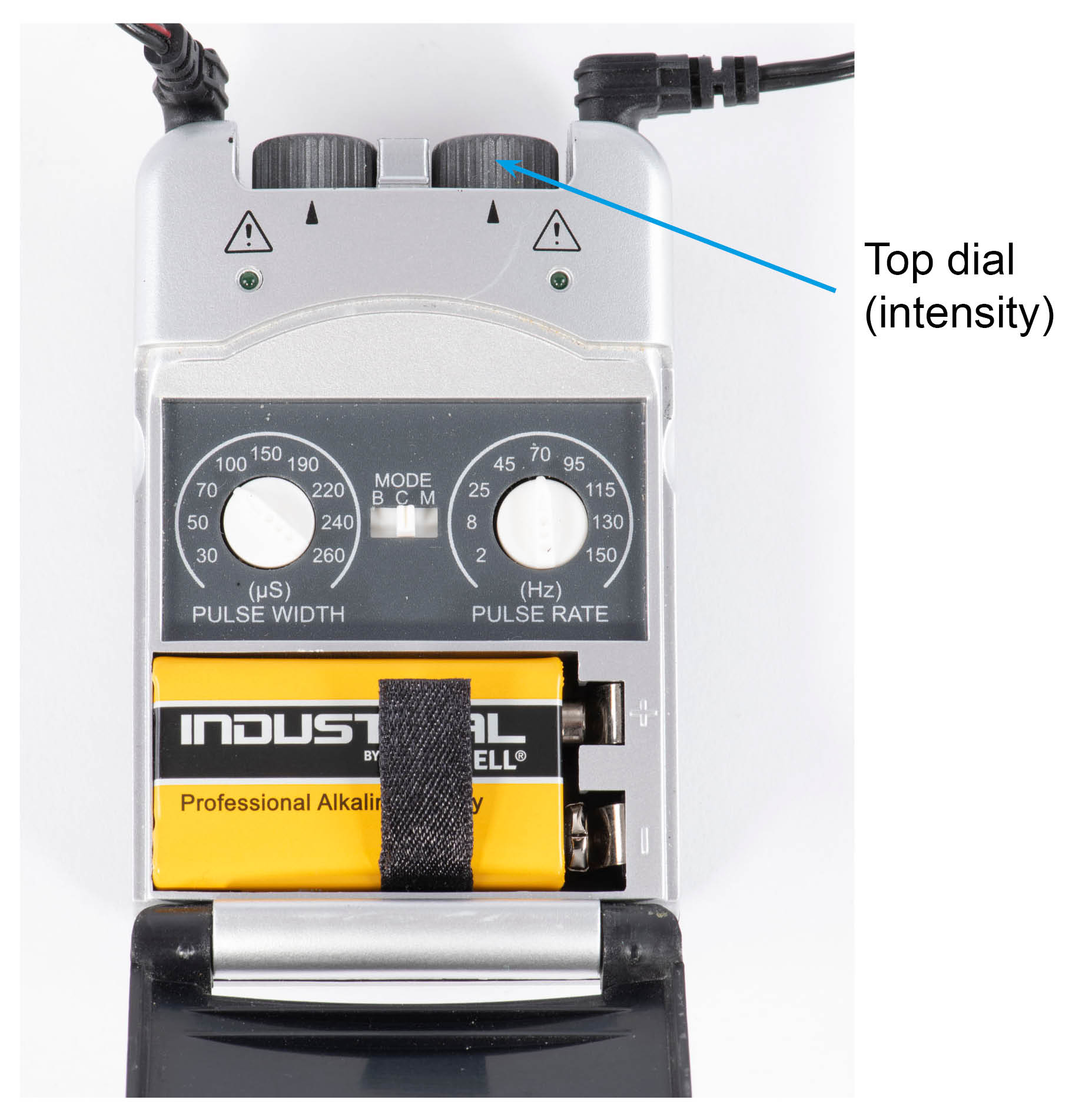 3. Switch on the machine and turn up the intensity (top dial) until you feel a comfortable tingle.
After 20 minutes or so you may find the tingling has dimmed or stopped. You will need to gradually increase the intensity (by turning the top dial) until you feel a comfortable tingle again.
What are the different modes?
Experiment by opening the machine and moving the mode switch (B, N, or M; some machines are marked C instead of N).
N = Normal (conventional) mode can be used for up to 12 hours a day.
B = Burst mode can be used for up to 12 hours but as it is felt stronger it does run the battery down more quickly. We suggest that you use the burst mode when your pain is bad (for 30 to 60 minutes) then return to the normal mode. You can use this ‘two step’ ladder throughout the day.
M = Modulation mode is a variation in setting that you can use if you find it more comfortable.
How do I look after the pads?
To look after the pads, please read the directions that are enclosed with the TENS pads. The following guidelines will help the pads to last longer.
Use with care when handling the pads. Do not pull by the wire.
Replace the pads on the protective sheet and seal in the protective cover.
If the pads feel dry or look dull, splash with a little water. Allow to dry before replacing them on the protective sheet.
How are the pads positioned on my body?
There are no hard and fast rules to positioning the pads. You can place them:
either side of your spine
over the nerve root, or
generally around or over the painful area.
Experiment with different pad positions to discover which work best in helping with your pain.
The leads have a black (negative) and a red (positive) end. Once again we encourage experimenting with the placement of these leads. Never position the pads over the pulses on the front of your neck.
Suggestions
The machine will be on loan to you. You must return it at your review appointment; we will send you the time and date of this appointment. Take the opportunity to get more out of it by experimenting with the inside settings.
Pulse width to, for example 60 to 150
By having the beats ‘wider’ the machine will feel stronger. You will need to make sure it feels comfortable. If the sensation feels uncomfortable or makes you feel nauseous (sick), it may help to reduce the pulse width. Remember the settings will vary depending on where you place the pads.
Pulse rate to, for example 20 to 130
We recommend you start at 70 but people often find that changing the ‘speed’ is helpful. Move the dial to see what is most comfortable.
General guidance
Always switch the machine off before applying or removing the pads.
Gently wash and dry your skin before applying the pads. Do not use creams or lotions as the pads will not stick.
You may need to change the position of the pads slightly each day. This will prevent your skin becoming irritated.
It is important to make sure the pads do not touch each other when on your skin.
Cautions
You may feel a strong jolt if a muscle is stimulated. This may feel uncomfortable but does not cause permanent damage. Reduce the intensity by turning down the top dial.
Skin irritation is unusual with the self-adhesive pads. If you do have an allergic reaction, please contact the Pain Clinic for further advice.
If you have an unpleasant prickling sensation:
check the pads are pressed down firmly on your skin; or
the pads have not dried out.
Do not use over broken, infected, or hypersensitive skin.
If after a couple of hours the tingling sensation ‘annoys’ you, turn the machine completely off for 5 minutes then switch it back on again. You can repeat this as often as needed.
Please remember to bring the TENS machine to your follow-up appointment. If you are unable to keep that appointment, please let the Pain Clinic know so we can offer your appointment time to another patient.
Further information
If you have any questions or concerns, please phone the Pain Clinic.
Kent Centre for Pain Medicine and Neuromodulation (direct lines)
Kent and Canterbury Hospital, Canterbury
Telephone: 01227 783049Queen Elizabeth the Queen Mother (QEQM) Hospital, Margate
Telephone: 01843 235094William Harvey Hospital, Ashford
Telephone: 01233 616691
Useful information
[Web site last accessed 10 July 2026]
Ask 3 Questions
There may be choices to make about your healthcare. Before making any decisions, make sure you get the answers to these three questions:
What are my choices?
What is good and bad about each choice?
How do I get support to help me make a decision that is right for me?
Your healthcare team needs you to tell them what is important to you. It’s all about shared decision making.
What do you think of this leaflet?
We welcome feedback, whether positive or negative, as it helps us to improve our care and services.
If you would like to give us feedback about this leaflet, please fill in our short online survey. Either scan the QR code below, or use the web link. We do not record your personal information, unless you provide contact details and would like to talk to us some more.
If you would rather talk to someone instead of filling in a survey, please call the Patient Voice Team.
Patient Voice Team
Telephone: 01227 868605
Email