Sacroiliac joint injections: The Kent Centre for Pain Medicine and Neuromodulation
Information for patients
This booklet will explain the following.
What sacroiliac joints are.
How sacroiliac joint injections may help with pain relief.
What happens during and after the procedure.
What the possible side effects are.
We hope this leaflet answers some of the questions you may have. If you have any further questions or concerns, please speak to your GP or other relevant healthcare professional.
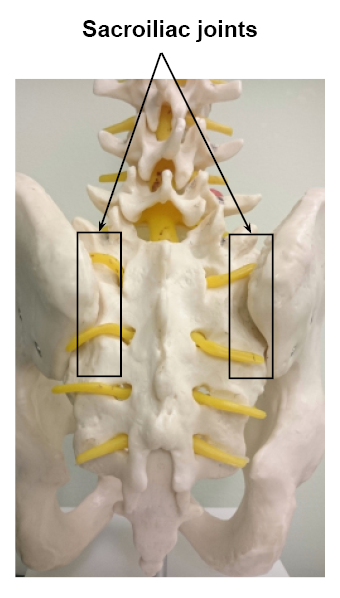
What are sacroiliac joints?
Sacroiliac joints lie next to the spine and connect the spine with the pelvis on both sides. There are two sacroiliac joints, one on the right and one on the left.
Sacroiliac joints do not move much, but they are essential weight bearing joints. Usually they cause no pain at all. However should one or both become inflamed or arthritic (also known as ‘wear and tear’) they can become painful.
How will a sacroiliac joint injection help?
A sacroiliac joint injection is one way of treating back pain that starts from these joints. This is not a cure but may reduce your pain temporarily.
A preparation of steroid and a local anaesthetic is injected in to or around these joints. This may reduce inflammation and pain.
Will I have to stay in hospital?
This procedure is carried out as a day case procedure (you can go home on the same day). The procedure is carried out in a Day Surgery theatre, to minimise your risk of infection. Shortly before your procedure we will ask you to change in to a theatre gown.
What happens during my procedure?
The procedure is carried out under x-ray control. This allows your doctor to identify the specific area to be treated. It is important that you tell your consultant if there is any possibility that you may be pregnant, as x-rays may harm your baby.
We will ask you to lie down on your front. Once you are lying in the correct position, the doctor will prepare the area to be treated with an antiseptic solution. This may feel cold.
The doctor will inject a local anaesthetic at the site of the procedure. This may sting to start with, before your skin goes numb.
A special hollow needle will be carefully inserted under x-ray guidance in to the correct position. It is important that you keep still during your procedure.
The doctor will inject a mixture of local anaesthetic and steroid in to the area.
We may repeat the above steps on both sides of your spine.
After the procedure, a small dressing will cover the injection sites. Please remove the dressing after 24 hours. Do not worry if the dressing falls off sooner.
What are the possible side effects?
There may be some pain and bruising at the needle site, which should settle over a few days.
You may have some bleeding from the needle site.
You may feel a little unsteady when you first stand.
The procedure may make your pain worse, this should stop within a few weeks.
There is a small risk of infection at the site of the injections.
You may have some leg weakness or numbness, which should stop over a few hours.
Female patients may have irregular periods, due to the use of steroids.
People with diabetes may have unstable blood sugar levels, due to the steroid injection.
Rarely, you may have mood changes due to the steroids.
Very rarely, there is a risk of temporary or permanent nerve damage.
What will happen after my injections?
You will be taken to the recovery area. You can go home 1 to 2 hours after your injection.
You must not drive for 24 hours following your procedure. Please arrange for someone to drive you home from the hospital. It is strongly recommended that you have someone stay at home with you until the following day.
Start your normal activities as soon as possible. However, avoid any strenuous activities for at least 1 day after your injections.
You may notice an immediate improvement. However, steroids work slowly, so even if the injections have worked well you may not notice any benefit for several days.
Sometimes there may be a slight increase in pain, but this should settle with time.
Will I need a follow-up appointment?
A telephone appointment will be made for a nurse to call you approximately 6 to 8 weeks after your procedure. You will be told by letter of the date and time for this appointment.
The nurse will review the outcome of your procedure. They will plan what happens next and discuss this with you during your telephone appointment.
If you continue to have good benefit from the procedure, you may be discharged from the Pain Clinic.
Further information
If you have any concerns regarding the information in this leaflet or your procedure, please phone the Pain Clinic.
Kent Centre for Pain Medicine and Neuromodulation (direct lines)
Kent and Canterbury Hospital, Canterbury
Telephone: 01227 783049Queen Elizabeth the Queen Mother (QEQM) Hospital, Margate
Telephone: 01843 235094William Harvey Hospital, Ashford
Telephone: 01233 616691
Useful information
[Web sites last accessed 13 February 2026]
Ask 3 Questions
There may be choices to make about your healthcare. Before making any decisions, make sure you get the answers to these three questions:
What are my choices?
What is good and bad about each choice?
How do I get support to help me make a decision that is right for me?
Your healthcare team needs you to tell them what is important to you. It’s all about shared decision making.
What do you think of this leaflet?
We welcome feedback, whether positive or negative, as it helps us to improve our care and services.
If you would like to give us feedback about this leaflet, please fill in our short online survey. Either scan the QR code below, or use the web link. We do not record your personal information, unless you provide contact details and would like to talk to us some more.
If you would rather talk to someone instead of filling in a survey, please call the Patient Voice Team.
Patient Voice Team
Telephone: 01227 868605
Email