Gastroscopy / Oesophageal dilatation
Information for patients from the Trust's Endoscopy Units
This leaflet is for patients who are having a gastroscopy with oesophageal dilatation examination. It explains what it involves, and any significant risks that there may be.
Please contact the Endoscopy Unit if you cannot come to your appointment. If you do not let us know in advance, we may remove you from the waiting list.
Students and trainees supervised by qualified staff may be involved in your care. If you do not want a student to be present, please tell the endoscopist or nurse-in-charge.
The time on your appointment letter is your booking-in time, not your procedure time. Please tell any friends or relatives coming with you to the hospital.
The test takes about 20 minutes. If there are emergencies or very complex cases, we may have to delay the start of your test. You may be in hospital for up to four hours.
What is a gastroscopy?
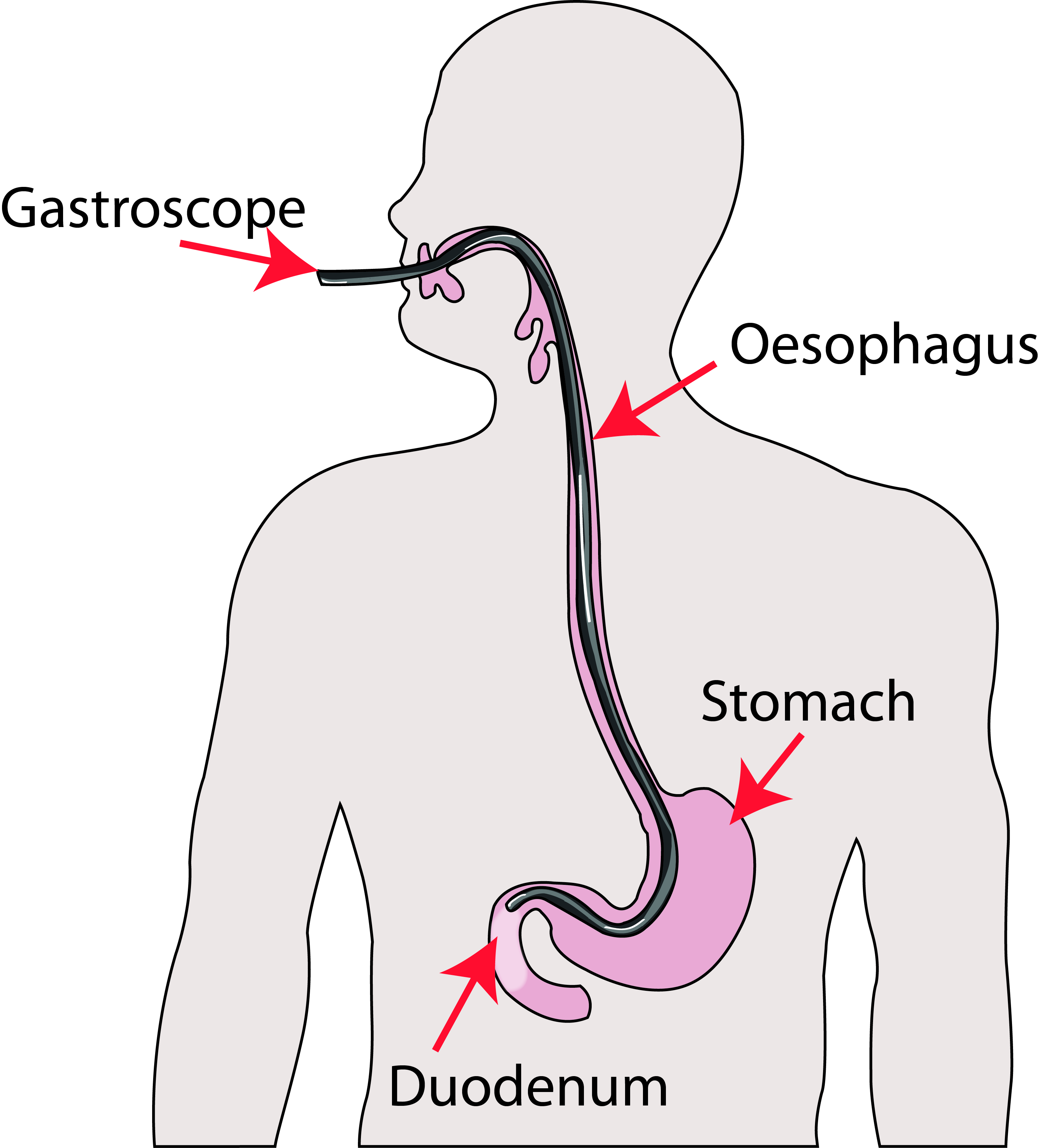
A gastroscopy is an examination of the inside of your:
oesophagus (gullet)
stomach
duodenum (the first bend of the small intestine)
A thin, flexible tube approximately the size of a woman’s little finger (a gastroscope) is passed through your mouth into your stomach. The tip of the gastroscope contains a light and a tiny video camera. This allows the endoscopist to see inside your gut, at what might be causing your symptoms. This procedure is sometimes called an endoscopy.
What is an oesophageal dilatation?
Oesophageal dilatation is a procedure to stretch open a narrowing in the oesophagus. The narrowing is slowing or preventing the passage of food through the oesophagus. The procedure is carried out during a gastroscopy. A balloon or gradual dilator is used to stretch open the narrowing.
X-rays are often used to check position and the result of the dilatation at the end of the gastroscopy.
An oesophageal dilatation takes longer than a routine gastroscopy. It may be painful, so most patients are normally given sedation and / or painkillers.
Depending on how you tolerate this procedure, you may be allowed fluids and be discharged from hospital within a few hours of your procedure. However, your endoscopist may decide that:
you should not eat or drink for a longer period of time; or
you need to stay in hospital overnight.
Your endoscopist may decide that you need an x-ray before you start drinking and eating, to check for complications.
How do I prepare for my test?
For this test to be successful, your endoscopist must have a clear view of your stomach. Your stomach must be as empty as possible.
It is important to have nothing to eat or drink for six hours before your test.
Important information for patients taking GLP-1 medication, such as Mounjaro, Wegovy, and Ozempic
Stop eating solid foods for 24 hours before your appointment. Drink clear fluids only (do not drink milk).
If you are a diabetic or haemophiliac, please phone the Endoscopy Unit for specific advice.
If you have a pacemaker / ICD, please phone the Endoscopy Unit at least one week before your test.
If you have been diagnosed with sleep apnoea and use a CPAP machine, please bring this with you to your appointment and tell the nurse on arrival.
Do not bring any valuables to the unit. Please note that East Kent Hospitals accepts no responsibility for the loss or damage to personal property. Unless the property has been handed in to Trust staff for safe-keeping.
Please remove any nail polish and all types of false nails before coming to hospital for your procedure.
Can I continue to take my normal medications?
If you take any of the following medication, phone the Endoscopy Unit at least one week before your test:
warfarin, clopidogrel, dabigatran, rivaroxaban, apixaban, edoxaban, or other blood thinning medications.
Continue to take other medications as normal, with a sip of water. Please bring a list of these with you to the Endoscopy Unit.
If you have any queries about your medication, please ring the Endoscopy Unit. It is important to remember to bring any asthma inhalers or angina sprays with you.
Advice for patients taking GLP-1 medications, for example Mounjaro
GLP-1 medications include:
Semaglutides, for example Wegovy, Ozempic, Rybelsus
Tirzepatide (Mounjaro)
Liraglutides
These medications are used to manage diabetes, cardiovascular disease, or weight loss. For patients who take these medications, food moves more slowly through their gut. As a result, if you take these medication you will need to stop eating earlier than other patients, to make sure your stomach is empty of food.
Do not eat food for 24 hours before your appointment. During this time, only drink clear fluids. Do not drink milk.
If you take your GLP-1 medication daily, please take your last dose 24 hours before your procedure.
If you take your GLP-1 medication weekly, please take your last dose one week before your procedure.
What happens when I arrive at the hospital?
Please report to the Endoscopy Unit reception on arrival.
A nurse will check your details, blood pressure, and pulse. If you are allergic to anything (such as medicine, latex, plasters), please tell the nurse.
You will need to change into a hospital gown, and your dressing gown and slippers.
We will explain the procedure to you during your admission. Please do not hesitate to ask any questions you may have. We will ask you to sign a consent form. Remember that you can withdraw your consent for treatment at any time.
We will ask you to remove any glasses, contact lenses, tongue studs, and dentures.
A nurse will stay with you throughout your examination.
Why do I need to sign a consent form?
All patients must give permission before they receive any type of medical treatment, test, or examination. Consent is usually given when you sign the consent form before your treatment, but we may ask you to give it verbally.
You must give your consent voluntarily.
The hospital must give you all the information you need to make a decision about your treatment. This is so you can give us informed consent. If you have not been given this information, or you have but you still have questions, please speak to a member of staff.
You must be capable of giving consent. This means that you understand the information given to you and can make an informed decision.
When we ask you to give consent, please use this time to ask any questions you may still have. For more information, please go to the NHS Consent for Treatment web page. Remember that you can withdraw your consent for treatment at any time.
What does the examination involve?
The nurse or endoscopist will discuss with you whether you will have a local anaesthetic (numbing) spray. We will spray this on the back of your throat. It has a bitter taste.
If you have sedation, we will insert a small needle into a vein in your hand / arm. We will give you the sedation before starting your examination. This will make you feel relaxed but rarely makes you fall asleep. The needle will be lightly strapped to your hand / arm until you recover from the procedure.
The endoscopist or nurse will attach a small device to your finger, to record your pulse and breathing. If you have sedation we will give you oxygen.
The nurse will place a cuff on your arm, this tracks your blood pressure if you have sedation. Please tell your nurse if there is a reason why we cannot use a certain arm.
We will ask you to lie on your left side. The endoscopist will place a small mouthpiece in your mouth. You will be given oxygen.
The endoscopist will gently insert the gastroscope into your stomach. This is not painful and will not make breathing or swallowing difficult. However, you may feel like retching and feel uncomfortable during your test.
Your stomach will be gently inflated with air to expand it. This is so the endoscopist can see the lining clearly. The air is sucked out at the end of the test.
The nurse may need to clear saliva from your mouth using a small suction tube.
A wire is passed through the gastroscope. The endoscopist may remove the gastroscope, leaving the wire in place.
The endoscopist will insert a balloon dilator through your oesophagus, using the wire as a guide.
The endoscopist may take a biopsy (a small sample of the lining of your oesophagus) during your examination. They will send this to the laboratory for more tests. You cannot feel this. The endoscopist may also take a video recording and / or photographs for your records.
What happens after my procedure?
The nurses will continue to monitor your condition and make sure you are comfortable.
You may have an x-ray at some point after your procedure.
You will not have anything to eat or drink:
for at least one hour after your test; or
until the nurse or endoscopist are happy with your recovery.
The nurse will tell you what you can eat and drink before you leave hospital. Generally you must chew your food well and avoid large chunks of food. Always have a drink with your meals.
Your throat may feel slightly sore. Please tell the nurse if you have any other pain or discomfort.
You must arrange for someone to take you home from hospital after your procedure. When home you must rest for the rest of the day.
Before you go home the nurse will explain your results. Any biopsy results will take longer.
We will send a letter to your GP.
Going home
If you had sedation, you must have a friend or relative:
take you home; and
stay with you for at least 24 hours after your procedure.
If you have had sedation, for 24 hours following your test you must not:
drive
drink alcohol
operate machinery, including the oven and kettle
sign important documents
You may have a mild sore throat, but this will pass and is nothing to worry about.
Eat a soft diet only for 48 hours following your procedure. If you have any questions, please speak to the nurse.
Are there any risks?
As with any procedure there are some risks.
Damage to crowned teeth or dental bridgework.
A reaction to the sedative. The sedative can affect your breathing, making it slow and shallow.
When a biopsy is taken there may be a little bleeding.
Fever (raised temperature).
There is a slightly increased risk of developing a chest infection after a gastroscopy.
A perforation is a little tear in the wall of the oesophagus. We can treat this with:
antibiotics and rest to allow healing; or
a stent can be placed to seal the tear; or
rarely an operation is needed.
Oesophageal scarring, making it difficult to swallow.
Please talk to your endoscopist before your examination if you have any worries about these risks.
Any further questions?
Please phone the Endoscopy Unit. The units are open Monday to Sunday 8am to 6pm.
Endoscopy Unit, Kent and Canterbury Hospital (K&C), Canterbury
Telephone: 01227 783058Endoscopy Unit, Queen Elizabeth the Queen Mother (QEQM) Hospital, Margate
Telephone: 01843 234370Endoscopy Unit, William Harvey Hospital (WHH), Ashford
Telephone: 01233 616274
If you have any questions between 6pm and 8am Monday to Sunday, please contact the Emergency Department (ED).
ED, Queen Elizabeth the Queen Mother (QEQM) Hospital, Margate
Telephone: 01843 235030ED, William Harvey Hospital (WHH), Ashford
Telephone: 01233 616207
Our units are regularly inspected and audited; please ask if you want any information about our performance standards. You can also visit the Care Opinion web site.
[Web sites last accessed 22 October 2026]
Ask 3 Questions
There may be choices to make about your healthcare. Before making any decisions, make sure you get the answers to these three questions:
What are my choices?
What is good and bad about each choice?
How do I get support to help me make a decision that is right for me?
Your healthcare team needs you to tell them what is important to you. It’s all about shared decision making.
What do you think of this leaflet?
We welcome feedback, whether positive or negative, as it helps us to improve our care and services.
If you would like to give us feedback about this leaflet, please fill in our short online survey. Either scan the QR code below, or use the web link. We do not record your personal information, unless you provide contact details and would like to talk to us some more.
If you would rather talk to someone instead of filling in a survey, please call the Patient Voice Team.
Patient Voice Team
Telephone: 01227 868605
Email